
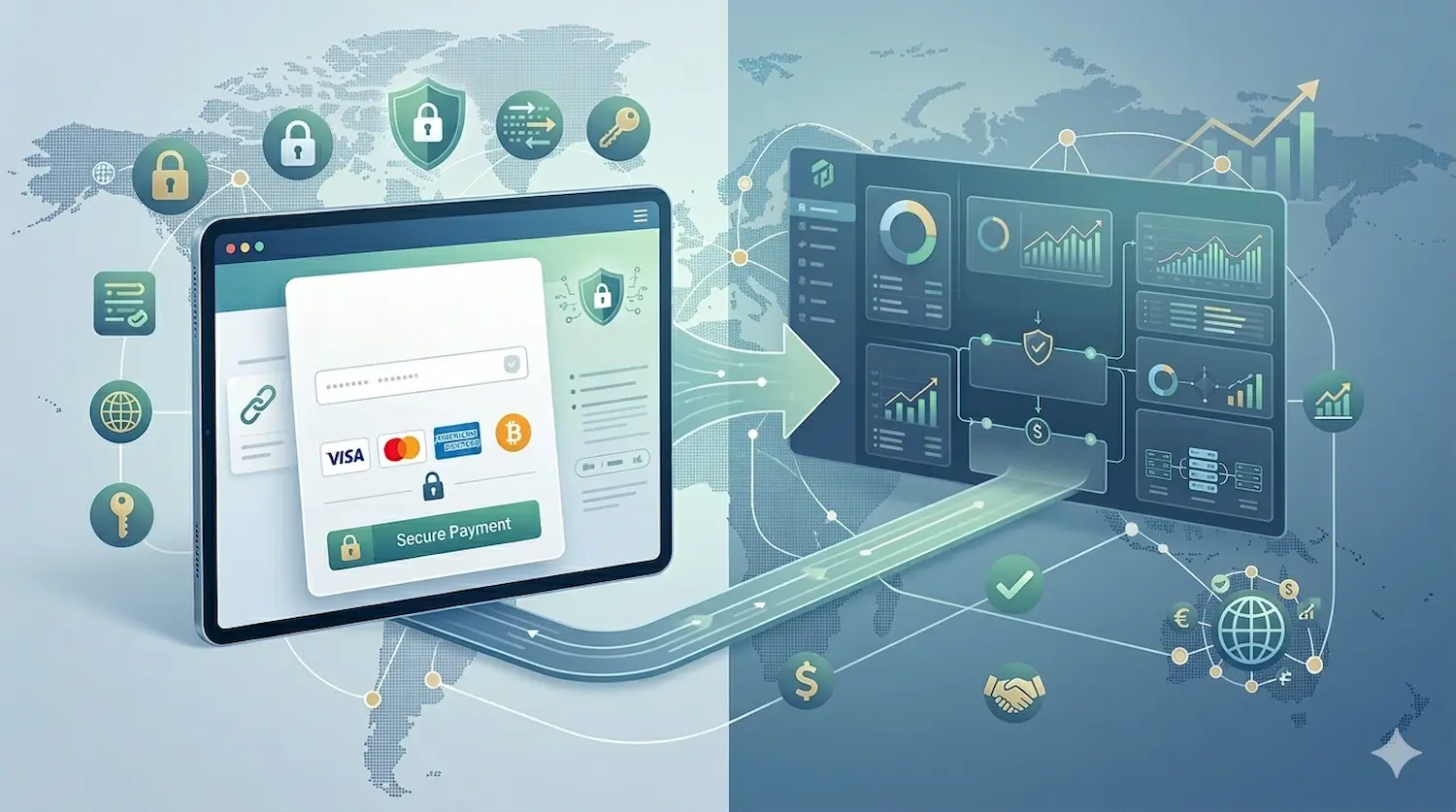
Payment gateway vs payment processor for high-risk businesses is one of the most important comparisons a merchant can make before choosing a payment setup.
For high-risk businesses, payments are rarely straightforward. Approval standards are tighter, chargebacks are monitored more closely, and many providers are selective about the industries they support. That is why understanding the difference between a payment gateway and a payment processor matters so much. While the two terms are often mentioned together, they do not mean the same thing.
This guide starts with those two terms and then places them inside the full payment stack, so you can see which layer does what: payment gateway, payment processor, payment service provider, acquirer, card network, issuer and merchant account.
If you are evaluating payment solutions for a high-risk business, learning how each part of the stack works can help you make better decisions about flexibility, onboarding, customer experience, and long-term growth. For a broader overview, you can also read our guide to high-risk payment gateways.
What is a payment gateway?
A payment gateway is the technology that captures payment details from the customer and sends that information securely through the payment flow.
In practical terms, it sits close to the checkout experience. It is the layer customers interact with when they enter card details, select a payment option, or complete an online purchase. A gateway helps make that process secure while connecting the transaction to the systems working behind the scenes.
For online businesses, a payment gateway may support:
- secure card payment forms
- hosted checkout pages
- cryptocurrency payment acceptance
- alternative digital payment methods
- a smoother customer-facing payment experience
What a gateway does not do matters just as much. It does not hold your money, it does not decide whether a card payment is approved, and it does not carry the financial liability for your chargebacks. Those responsibilities sit further down the stack, with the acquirer and the issuer.
For high-risk merchants, the gateway matters because it affects more than usability. It also shapes how flexible and accessible the payment experience is.
What is a payment processor?
A payment processor is the service that handles the transaction once the payment information has been captured.
Its role is to move the payment through the financial system, communicate with the relevant banking and network infrastructure, and help determine whether the transaction is approved or declined. The customer may never see this part directly, but it is central to whether the payment actually goes through.
Where the gateway is the door the customer walks through, the processor is the courier that carries the message. It formats the authorisation request, delivers it towards the acquirer and the card network, returns the approve-or-decline answer to the checkout, and later submits the transaction for clearing and settlement.
While the gateway is closer to the checkout, the processor is closer to the backend transaction flow.
Payment Gateway vs Payment Processor for High-Risk Businesses: the simple difference
The simplest way to understand payment gateway vs payment processor for high-risk businesses is this: a payment gateway helps collect and transmit payment information securely, and a payment processor helps move the transaction through the payment network. They work together, but they do different jobs.
For a lower-risk merchant, that difference may seem technical. For high-risk businesses, it becomes much more practical. A poor setup can create friction during onboarding, limit payment options, or make the business more vulnerable to operational issues later.
The rest of the stack: PSP, acquirer, card network, issuer and merchant account
Gateway and processor are only the two layers merchants meet first. A card payment involves five more roles, and most disagreements about who is responsible for what come from confusing them.
Payment service provider (PSP)
A payment service provider bundles the gateway, the processing connection and a payment account into a single relationship. Instead of contracting a gateway from one company, processing from another and an acquiring arrangement from a third, the merchant signs once and integrates once.
The trade-off is control. Under an aggregated PSP model, merchants often process under the provider’s acquiring arrangement rather than holding their own merchant identification number, which makes launching faster but ties the account more closely to the provider’s own risk appetite. In the European Union, payment service providers operate within the regulatory framework set out under the EU payment services rules, which is why onboarding involves verification rather than a sign-up form.
Acquirer
The acquirer, or acquiring bank, is the licensed institution that holds the merchant’s card acquiring relationship. It is a member of the card networks and submits the merchant’s transactions into them.
For a high-risk business, the acquirer is usually the layer that decides whether the business can process cards at all. It underwrites the merchant, sets the reserve and risk conditions, carries the financial liability if chargebacks exceed what the merchant can cover, and settles the funds. When merchants say they were declined, offboarded or put on a rolling reserve, that decision almost always originated here rather than at the gateway. Our guide to card acquiring and crypto settlement covers how that relationship works alongside a crypto rail.
Card network
Card networks such as Visa and Mastercard operate the rails and the rulebook between the acquirer and the issuer. They route the authorisation message, define interchange and scheme fees, and set the dispute rules that decide how a chargeback is categorised and who wins it.
A card network does not hold the merchant’s account or the cardholder’s account, and it does not approve individual payments. It is closer to the road and the highway code than to either driver. That distinction matters for high-risk merchants, because the rules that constrain a category, such as monitoring programmes for excessive chargebacks or fraud, are written at network level and then enforced by the acquirer.
Issuer
The issuer, or issuing bank, is the customer’s bank. It issued the card, it holds the funds or the credit line behind it, and it makes the actual approve-or-decline decision on each payment.
The issuer is also where authentication happens. Under the EMV 3-D Secure protocol, the issuer decides whether a payment is authenticated invisibly or whether the customer is challenged, and it is the issuer that funds a chargeback when a cardholder disputes a transaction. Our guide to 3D Secure and SCA for high-risk payments covers this in detail.
Merchant account
A merchant account is the account, held with or through an acquirer, where card proceeds sit after a transaction has cleared and before they are paid out to the ordinary business bank account. It is where the settlement schedule applies and where reserves are held back.
Merchants with their own account have a direct acquiring relationship and, usually, more negotiating room. Merchants under an aggregated PSP do not hold one at all: they sit under the provider’s arrangement. Neither is automatically better, but they fail in different ways, which is why how a high-risk merchant account actually gets approved is worth reading before applying.
The payment stack at a glance
The table below sets out each component, what it is for, and who it answers to.
| Component | Main role | Who it serves | Typical responsibility |
|---|---|---|---|
| Payment gateway | Captures payment details at the checkout and passes them into the payment flow | The merchant and the customer | The customer-facing acceptance layer: checkout, payment methods, payment data in transit |
| Payment processor | Moves the transaction through the payment system | The merchant and the acquirer | Formatting and routing authorisation, clearing and settlement messages |
| Payment service provider (PSP) | Bundles gateway, processing and a payment account into one relationship | The merchant | One contract, one integration and one payout instead of several separate partners |
| Acquirer | Holds the merchant’s card acquiring relationship and scheme membership | The merchant | Underwriting, risk and reserves, chargeback liability, settling funds to the merchant |
| Card network | Operates the rails and the rulebook between acquirer and issuer | The whole ecosystem, not one party | Routing messages, setting interchange and scheme fees, defining dispute rules |
| Issuer | Issues the customer’s card and holds their funds or credit line | The cardholder | Approving or declining the payment, applying authentication, funding chargebacks |
| Merchant account | The account the card proceeds sit in before they reach the business bank account | The merchant | Holding settled funds and reserves, and paying out on the agreed settlement schedule |
For a short definition of each component named here — gateway, processor, PSP, acquirer, issuer and merchant account — see the payment glossary.
How a card payment moves through the stack
Conceptually, a card authorisation travels in one direction and the answer comes back along the same path:
- Customer – enters card details, or approves the payment in a wallet, at the checkout.
- Gateway or PSP – captures the payment data and creates the payment request.
- Processor – formats that request and routes it onward.
- Acquirer – submits the request into the card network on the merchant’s behalf.
- Card network – routes it to the correct issuer under the scheme rules.
- Issuer – approves or declines, applying authentication where it is required.
The approval or decline then travels back along the same path to the checkout, usually in a couple of seconds. Clearing and settlement follow afterwards on a separate schedule, which is why the money reaches the merchant days after the customer sees the payment succeed.
Real architectures vary. Many providers hold more than one of these roles at once, some acquirers run their own processing, and a payment orchestration layer can sit above the whole chain to route the same transaction to different providers. Crypto payments skip the chain entirely: there is no acquirer, no card network and no issuer, only the blockchain confirming the transfer.
Why this matters more for high-risk businesses
High-risk merchants usually need to pay closer attention to payment infrastructure than standard ecommerce businesses.
That is because high-risk sectors often deal with stricter underwriting, higher dispute exposure, rolling reserves, greater provider scrutiny, fewer available payment partners, and more pressure to maintain stable payment acceptance.
In that environment, it is not enough to ask whether a provider can accept payments. You also need to understand what part of the payment stack they actually provide and whether that matches your business model.
A gateway may offer a simple checkout and broad payment method support, but that does not automatically mean the processing side is a strong fit for your risk profile. In the same way, a processor may be willing to work with a high-risk category, but that does not guarantee the payment experience is flexible or easy to integrate.
The role of the gateway in high-risk payment strategy
For high-risk businesses, the gateway is not just a checkout tool. It can shape how customers pay, what payment methods are available, and how easy the setup is to deploy.
This matters because many high-risk merchants want more than a basic card form. Some need to accept card payments and cryptocurrency payments side by side. Others want a more global payment experience for customers across different markets.
A strong payment gateway can support that by making the acceptance layer more adaptable. It helps businesses present payment options in a cleaner, more modern way while reducing friction for both merchants and customers. If crypto acceptance is part of your strategy, our article on crypto payment companies offers more context on what businesses are looking for today.
The role of the processor in high-risk payment strategy
The processor matters for different reasons.
For high-risk businesses, the processor is more closely tied to transaction handling, approvals, reserves, and provider tolerance. This is where operational stability becomes more important. It is also where merchants may run into tighter controls depending on the industry, business model, or transaction patterns.
So while the gateway influences how payments are accepted, the processor influences how those payments move through the broader system. The comparison should not be framed as choosing one instead of the other: the smarter question is what each one does and how the two fit together in a workable setup.
Do high-risk businesses need both?
In most cases, yes. A high-risk business typically needs both a payment gateway and a payment processor, whether they are bundled together or provided by different partners. Behind them it also needs an acquiring relationship and somewhere for settled funds to land, even when a PSP arranges both on the merchant’s behalf.
Some businesses prefer an all-in-one setup because it is easier to launch. Others want more control and choose separate solutions for the gateway and the processing side. The right structure depends on the business model, target regions, payment methods, and internal technical needs. What matters most is understanding each role clearly rather than treating the whole payments stack as one product.
What to compare when evaluating payment solutions
When comparing payment options, high-risk merchants should look beyond labels and focus on fit.
Some of the most useful questions include:
- Which layers of the stack does this provider actually operate, and which does it resell?
- Does the solution support the payment methods your customers want to use?
- Is the checkout easy to integrate and maintain?
- Is the provider comfortable working with high-risk businesses?
- What are the settlement terms, the reserve and the payout threshold?
- Will the infrastructure still work as the business grows?
These are the questions that make the comparison genuinely useful. The goal is not only to understand the terminology, but to make a better payment decision. If you are still preparing for setup, it may also help to review a high-risk payment gateway onboarding checklist before speaking to a provider.
Where Niftipay fits in the payment stack
Niftipay describes itself in its developer documentation as a payment gateway, and that is where it sits in this comparison: on the acceptance side of the stack, not on the card network or issuing side.
On the card side, Card Payments covers Visa and Mastercard credit, debit and prepaid cards, plus Apple Pay and Google Pay. American Express is not supported. Card details are entered on a payment page hosted and operated by Niftipay rather than on the merchant’s own domain, and 3D Secure is applied when the issuing bank or the transaction flow requires it. Merchants connect through hosted checkout, payment links, WooCommerce and PrestaShop plugins, or the REST API and webhooks.
Niftipay also handles the merchant-facing end of settlement for the payments it takes. Standard card settlement is T+9, payouts go to a bank account in EUR, GBP or USD or to a USDT wallet depending on the approved setup, the minimum payout threshold is USD 500, and an initial rolling reserve of 10% is held for 181 days. Chargeback evidence remains the merchant’s responsibility.
On the crypto side the stack is shorter. Crypto Payments accepts BTC, ETH, SOL, LTC, XRP, USDT and USDC, with USDT and USDC on the ERC-20 network only, and the merchant receives the same asset the customer paid into their Niftipay balance. There is no acquirer, no card network and no issuer in that flow, and no conversion into fiat.
It is worth being precise about what that does not include. Niftipay is not a card network and it is not the issuer of your customer’s card. It does not remove the need for acquiring: availability depends on whether acquiring is supported for a given business model and jurisdiction. And on the product side there are no subscriptions, no recurring billing and no card-on-file, so saved cards and renewal logic stay in the merchant’s own billing platform. Every card payment is taken as an individual transaction.
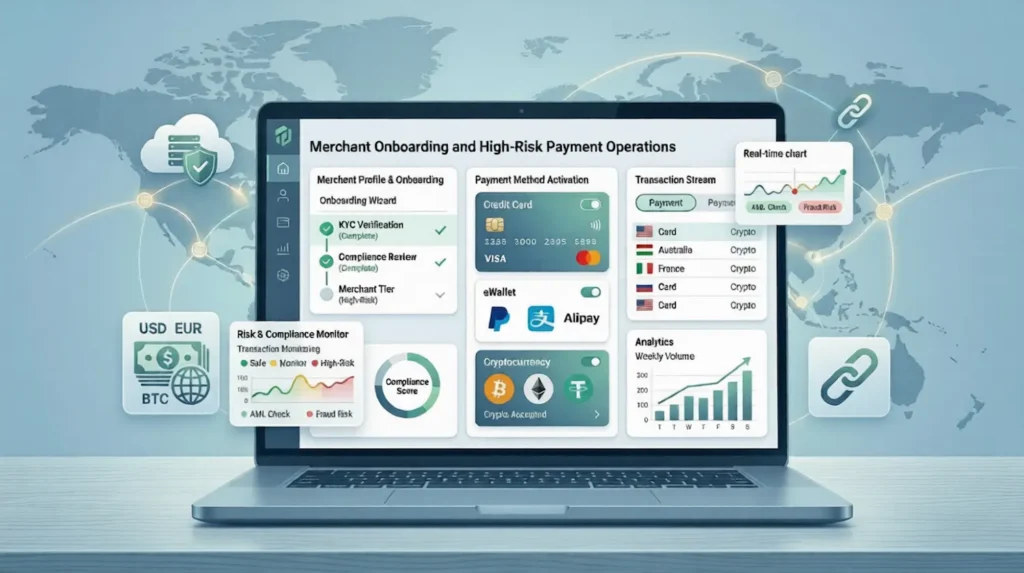
Card and crypto acceptance both require merchant qualification, know-your-business verification and a compliance review, carried out by a person rather than scored automatically, normally within two to five business days.
Common confusion: treating the whole stack as one product
One of the most common mistakes merchants make is assuming that the customer-facing payment experience, secure payment data transfer, transaction handling, settlement and risk management all belong to one identical service. They do not, and the seven roles above are usually spread across at least three companies.
Once that distinction is clear, comparing providers becomes much easier, because you can ask each one which layer it actually controls. For merchants dealing with disputes, our guide on how to reduce chargebacks in high-risk industries is a useful next read.
What high-risk businesses should take away
The difference between a payment gateway and a payment processor becomes much easier to understand once the jargon is removed.
A payment gateway helps your business collect and send payment information securely. A payment processor helps move that transaction through the financial system. Behind them, the acquirer decides whether you can process at all, the card network sets the rules, the issuer decides each individual payment, and the merchant account is where the money waits.
For high-risk businesses, that distinction matters because payments influence much more than checkout alone. They affect onboarding, payment flexibility, operational stability, and the overall customer experience. Businesses selling across borders may also need to think more carefully about international payments as part of that setup.
And for businesses that want to explore a gateway that supports card payments and crypto payments through one acceptance layer, the Niftipay New Client Service Request Form is a natural place to continue that conversation.
Payment gateway vs payment processor FAQs
Is a payment gateway the same as a payment processor?
No. A payment gateway captures payment details at the checkout and passes them into the payment flow. A payment processor moves the resulting transaction through the payment system and carries the authorisation, clearing and settlement messages. Many providers sell both together, which is why the two words are often used as if they meant the same thing.
What is a PSP in payments?
A payment service provider is a company that bundles the gateway, the processing connection and a payment account into a single relationship, so the merchant signs one contract and builds one integration instead of assembling the layers separately. Under an aggregated PSP model the merchant often processes under the provider’s acquiring arrangement rather than holding its own merchant identification number.
What does an acquirer do?
An acquirer, or acquiring bank, is the licensed institution that holds the merchant’s card acquiring relationship. It is a member of the card networks, submits the merchant’s transactions into them, underwrites the merchant, sets reserve and risk conditions, carries the financial liability for chargebacks, and settles the funds the merchant is owed.
What is the difference between an acquirer and an issuer?
The acquirer sits on the merchant’s side of the transaction and the issuer sits on the customer’s side. The acquirer submits the payment request and receives the funds for the merchant. The issuer holds the cardholder’s account, decides whether to approve or decline the payment, and funds a chargeback when the cardholder disputes it.
Where does a merchant account fit into payment processing?
A merchant account is the account, held with or through an acquirer, where card proceeds sit after the transaction has cleared and before they are paid out to the business bank account. It is where reserves are held and where the settlement schedule applies. Under an aggregated PSP model a merchant may not hold its own account and instead sits under the provider’s.
Is Niftipay a payment gateway or a payment processor?
Niftipay describes itself in its developer documentation as a payment gateway. It operates the acceptance layer: the hosted checkout, payment links, QR payments, plugins, the REST API and the merchant dashboard, along with the approved payout setup for the funds it settles. It is not a card network, it is not the issuer of the customer’s card, and card acquiring availability still depends on whether an acquirer supports the merchant’s model in its markets.